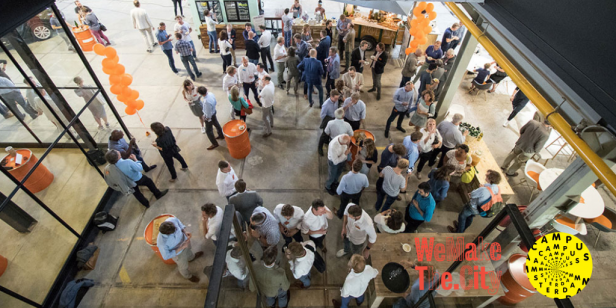
We are an open network that connects all innovation districts, campusses and hubs of the region of Amsterdam. Every other month we are travelling to a different innovation hub to discover what they are up to and how we can possibly work together on global challenges. On 18th March we are organising a public meetup at Prodock! Sign up for free via the link.
Want to receive updates like this in your inbox?
Get notified about new updates, opportunities or events that match your interests.
Maybe you will also like these updates
Waag Open: Electric Garden

In de hoop dat technologie ons uit de klimaatcrisis redt, worden er miljoenen geïnvesteerd in technologieën op het gebied van kunstmatige intelligentie. Tegelijkertijd genereert de hele IT-industrie nu al 900 Megaton aan CO2 per jaar. Dat is zeven keer zoveel als de uitstoot van heel Nederland in 2023. Technologische innovatie en een gezond ecosysteem lijken niet samen te gaan. Kunnen technologie en natuur samenwerken bij het redden van onze planeet?
Kunstenaar Sunjoo Lee experimenteert in haar project ‘Electric Garden’ met een elektriciteitsproducerende tuin. Zolang het ecosysteem in haar tuin bloeit, kan elektriciteit worden opgewekt. Tijdens deze Waag Open in juli maken we een eigen Electric Garden in de Waag. In een boeiende workshop neemt Sunjoo je mee in de wereld van regeneratieve technologie en leer je hoe de natuur als duurzame energiebron kan fungeren.
Programma
| 19:15 - 19:30 uur | Inloop |
|---|---|
| 19:30 - 19:45 uur | Welkom & introductie |
| 19:45 - 21:30 uur | Workshop Electric Garden |
Over Electric Garden
Electric Garden verkent op creatieve wijze de mogelijke samenwerking tussen natuurlijke ecosystemen en digitale systemen. De tuin produceert elektriciteit via het metabolisme van anaerobe bacteriën die in natte grond leven, met behulp van een technologie die Microbial Fuel Cells wordt genoemd. Elke container werkt als een batterij en is uitgerust met elektroden die de elektronen oogsten die door de bacteriën worden uitgezonden. De planten en insecten in de tuin voeden de bacteriën. Zolang het ecosysteem bloeit, kan elektriciteit worden opgewekt.
Over Sunjoo Lee
Sunjoo Lee is een interdisciplinair kunstenaar. Haar werk bevindt zich op het snijvlak van kunst, technologie en ecologie. Ze is gevestigd in Nederland en Zuid-Korea en is gefascineerd door het gebruik van elektronica en digitale hulpmiddelen die het menselijk belang overstijgen. In haar werk verkent ze onderwerpen als meer dan menselijke filosofie, emergentie, biomimicry, toekomstige vormen van symbiose en permacomputing.
Waag Open
Elke eerste donderdagavond van de maand opent Waag haar deuren! Kom langs om te discussiëren en te doen. Want we gaan niet alleen in discussie over maatschappelijke thema's en de toekomst – je leert daarnaast ook altijd iets praktisch. Iets dat je altijd al hebt willen uitproberen, zoals de 3D-printer in het FabLab, of juist iets dat je nooit had verwacht, zoals uitpluizen hoe DNA in elkaar zit in ons biotech-lab. Waag Open vindt plaats in de maakplaatsen op de eerste en tweede verdieping van het historische Waaggebouw op de Nieuwmarkt.
Toegankelijkheid
Mocht je krap bij kas zitten en wel graag aan dit evenement willen deelnemen, neem dan contact op met sanna [@] waag [punt] org.
Enabling the Future with High Tech

Societal challenges such as climate change, geopolitical security issues, and an ageing population are widely recognised. However, the fact that photonic, nano, and quantum technology can provide solutions to these global problems remains largely unknown to many.
Addressing these major dilemmas requires an approach in which technology plays a central role. Key enabling technologies in general – and photonics, nano, and quantum technology in particular – are therefore in the spotlight when it comes to the strategic plans of businesses and governments.
These technologies enable, for instance, secure communication, the development of smarter and more cost-effective sensors, and the creation of highly targeted medicines.
Who is it for?
This symposium is intended for professionals working in industry, public institutions, and knowledge organisations. Potential attendees include:
🔹 Scientists and researchers – Academics and researchers in physics, electrical engineering, materials science, and nanotechnology
🔹 Engineers and technologists – Professionals working on optical systems, semiconductors, quantum computing, and nanotechnology
🔹 Students and PhD candidates – Master's and PhD students in physics, computer science, and engineering
🔹 Industry experts and entrepreneurs – Companies and startups in high-tech sectors such as photonics, quantum computing, telecoms, and sensor technology
🔹 Government and policymakers – Organisations driving innovation, such as ministries, EU programmes, and investment funds
🔹 Investors and venture capitalists – Investors interested in deep-tech startups and the commercial applications of these technologies
Sign up right now - admission is free!
Underground Challenges and Shared Solutions: Lessons from Amsterdam for District Heating in Haarlemmermeer

How do you install district heating in villages with narrow streets and limited underground space? This was the central question during a recent deepdive session hosted in the municipality of Haarlemmermeer. The session brought together experts from the City of Amsterdam, local officials and experts from Haarlemmermeer, and Arcadis to explore practical solutions to the physical challenges of implementing district heating in dense and complex infrastructure environments.
From complexity to coordination
Amsterdam has years of experience addressing similar challenges in dense urban areas where underground infrastructure is already under pressure. Experts from the City of Amsterdam were invited to share their approach, which combines long-term planning, integrated design processes, and flexibility in applying standards.
Some key principles they shared:
- Planning 15 years ahead: Amsterdam actively involves all utility providers to map out future plans and co-create underground infrastructure layouts.
- Using standard ways of working in the underground (WIOR) and a standardised scheme for subsurface infrastructure planning: These frameworks help assess available underground space and guide decisions when concessions are necessary.
- Embracing alternative methods: Stacking pipelines instead of placing them side-by-side, drilling under roads, or clustering transport cables in walls or consolidated zones are all viable options.
Sometimes, this requires deviating from standard spacing requirements. Such exceptions are only made with strong justification and agreement at the decision-making level.
A fresh look at Haarlemmermeer’s challenges
Participants from Haarlemmermeer acknowledged that they face several pressing issues. With limited space in the underground and a lack of an integrated planning framework, it is difficult to make informed, long-term decisions. Three villages in the municipality are particularly challenging due to their narrow streets and aging infrastructure.
Key challenges included:
- Underestimating the space needed for district heating infrastructure (including expansion loops, communication lines, and insulation).
- Rigid adherence to guidelines, which may not always be feasible locally.
- A missing coordinating role to oversee all the different parties operating in the underground to facilitate collaboration.
Shared lessons, shared responsibility
The session made clear that while every context is different, the challenges of underground infrastructure for district heating are shared across municipalities. The city of Amsterdam is a bit further ahead than Haarlemmermeer, and their expertise was already tremendously helpful. The Amsterdam case shows that smart, flexible planning—backed by clear coordination of all parties active in the underground —can lead to effective, long-term solutions.
Now the task for Haarlemmermeer is to translate these insights into concrete next steps. As one participant concluded, “We need to move from awareness to action.”
Would you like to learn more about this topic? Please contact Noor at noor@amsterdaminchange.com.