Since 2010 De Dakdokters (The Roofdoctors) transform the roofs of Amsterdam. Let us show you some of our most interesting solutions and be inspired by our vision.
An excursion takes between 1,5 and 5 hours, depending on the number of roofs.
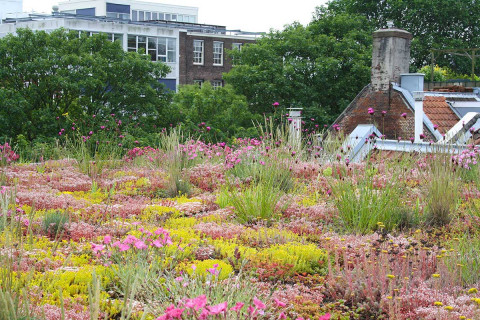
Since 2010 De Dakdokters (The Roofdoctors) transform the roofs of Amsterdam. Let us show you some of our most interesting solutions and be inspired by our vision.
An excursion takes between 1,5 and 5 hours, depending on the number of roofs.
Get notified about new updates, opportunities or events that match your interests.

The pioneering innovations were presented of the Scale Up Future-proof artificial turf pitches project, a collaboration between Amsterdam and Haarlem focused on sustainable artificial turf pitches. Over the next few years, more than 250 sports pitches in both cities will be transformed into circular, energy-generating and climate-adaptive sports venues. These artificial turf pitches can not only generate and store energy, but also involve smart water management. An approach that is globally relevant for urban sports infrastructure.
Three consortia collaborate on the sport pitch of the future
The three selected consortia Antea Sport, EnergieVeld and GOO4iT together comprise more than 15 market players. They join forces within this innovation partnership, where there is room for long-term collaboration, co-creation and scalable innovation. The pioneering solutions will make it possible to cool down sport pitches on warm days, help dispose of and collect rainwater, make the pitches more pleasant for the users and possibly even generate energy for the surrounding area. Find out how these innovations are shaping the sport pitch of the future here.
Two municipalities: joint procurement
The Scale Up Future-proof artificial turf pitches project is a unique collaboration between two municipalities and market players. The municipalities jointly procure pooling their purchasing power and use an innovation partnership to challenge the market to test and scale up innovative and sustainable solutions. In doing so, the solutions are also scalable and transferable to other cities in the Netherlands and Europe.
From prototype to pilot fields
The first prototype fields will be constructed in Amsterdam and Haarlem in 2026, in different capacities and combining multiple innovations, where they will be extensively tested and monitored for a year. Successful concepts are then scaled up to full-scale pilot pitches and tested and monitored for another year. This will form the basis for the new standard of sustainable sports pitches, with potential for adoption in other cities around the world. At the same time, existing pitches are already being improved with the most sustainable solutions available, making an immediate impact from the start. The project thus shows how cooperation between municipalities and market players can lead to innovative, climate-proof sports infrastructure with international relevance.
Join us
This project provides cities worldwide a blueprint for sustainable, smart, and future-proof artificial turf pitches. Interested municipalities and industry partners can get in touch and subscribe to our news updates by sending an e-mail to: sportveldvandetoekomst@amsterdam.nl.

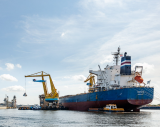
During Demoday #28, we focused on one of the key challenges in the circular transition: how can we make the Port of Amsterdam fully circular?
The Amsterdam port is one of the largest in Europe. It functions as a major energy hub, where fossil fuels still play a central role, and as an industrial hub, where massive flows of raw materials pass through. The City of Amsterdam has set the ambitious goal of becoming fully circular by 2050. This means the port must transform as well. This is a complex and far-reaching task that requires collaboration and innovation.
In this work session, we zoomed in on circular design: how can we make products and processes circular from start to finish?
James Hallworth, Commercial Manager at Port of Amsterdam, opened the session by taking the group on a tour through the world of the port. Located in the western harbour area, the port has two main responsibilities. First, it ensures the smooth and safe handling of all maritime traffic on behalf of the City of Amsterdam. Second, it manages and develops the land and industrial areas around the harbour.
To tackle circularity, Port of Amsterdam applies industrial ecosystem thinking. In nature, waste does not exist, and the same principle should apply here. The port aims to build collaborative networks between companies, where waste flows from one company becomes raw materials for another. There is already significant activity around recycling and recovery, but more can be done in higher-value strategies on the R-ladder, such as repurposing, remanufacturing, and refurbishment. Circular by design is a key concept in this shift.
The port is transitioning from measuring success in tons to measuring added value. This shift also means thinking differently about space: circular systems require space to receive, process, and recover valuable materials from waste streams.
Creating a fully circular production process is easier said than done. That’s why we worked through two real-world cases: construction materials and e-bikes. Participants split into groups and explored what a truly circular production process might look like. We also explored the potential role the port could play as an enabler of circular supply chains.
Some key takeaways from the session:
• Material passports: A digital document containing material properties and origin can greatly simplify recycling and reuse.
• Monomaterials: Products made from a single type of material are much easier to separate and recycle at the end of life.
• Smart synergies: Mapping which companies can use each other’s waste flows as input can unlock huge circular potential.
• Financial incentives: Right now, circular processes are often more expensive than linear ones. Smart financial mechanisms could help bridge that gap.
• E-bike challenges: In the case of e-bikes, batteries were flagged as a challenge. Recycling them is still very difficult, and since they are mostly produced outside of Europe, it’s hard to have control over the production process.
This session invited participants to take a step back and view products through a circular lens. The port has the potential to become a key player in the circular transition, but to get there, it will need ideas, insights, and input from across the network.
<strong>Do you have ideas on how the Port of Amsterdam can become more circular? Or would you like to contribute to future sessions? Get in touch with Noor at noor@amsterdaminchange.com. A big thank you to James Hallworth from Port of Amsterdam for bringing this challenge to the network, and Yanti Slaats (Amsterdam University of Applied Sciences) for moderating the session.</strong>
𝗥𝗼𝗯𝗼𝘁𝗶𝗰𝗮 𝗯𝗶𝗲𝗱𝘁 𝗸𝗮𝗻𝘀𝗲𝗻. 𝗠𝗮𝗮𝗿 𝗮𝗹𝗹𝗲𝗲𝗻 𝗮𝗹𝘀 𝗷𝗲 𝘄𝗲𝗲𝘁 𝘄𝗮𝗮𝗿 𝗷𝗲 𝗺𝗼𝗲𝘁 𝗯𝗲𝗴𝗶𝗻𝗻𝗲𝗻.
Welke taken kun je automatiseren zonder je hele proces om te gooien?
Hoe weet je of cobots geschikt zijn voor jouw productieomgeving?
En wat kost het – in tijd, geld én kennis – om echt aan de slag te gaan?
Op woensdag 23 april organiseren we een Innovation Dinner over robotica, samen met BouwLab R&Do – speciaal voor professionals in de maak- en bouwsector die serieus werk willen maken van slimme productie.
Franc Mouwen (European Innovation Council) deelt zijn inzichten over technologische doorbraken en de stappen die bedrijven écht verder helpen – van technische kennis opbouwen tot financiering en samenwerking.
Na het dinner kun je kiezen voor een tweedelige workshopreeks waarin we samen de praktijk induiken: wat werkt, waar begin je en hoe zorg je dat het blijft werken?
📅 Workshops: 7 & 14 mei | 13.00-17.00 uur
🆓 Deelname is kosteloos
𝗩𝗿𝗮𝗴𝗲𝗻? Mail Sem via sem@3dmz.nl.