De Gezonde Stad is a foundation that connects inhabitants, companies and local government within Amsterdam to create a more sustainable and healthy city. De Gezonde Stad initiated Park om de Hoek.
De Gezonde Stad is a foundation that connects inhabitants, companies and local government within Amsterdam to create a more sustainable and healthy city. De Gezonde Stad initiated Park om de Hoek.

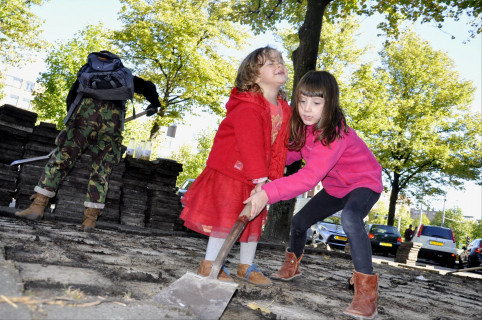
The aim is to empower inhabitants to (re)create their neighborhood by their own needs, ideas and wishes. Cities are transforming more and more into concrete jungles, leaving not much space for green zones. Whilst a green city is a healthy city: greenery reduces the urban heat island effect and sewage overflows. At the same time we can create green zones to stimulate biodiversity and happier inhabitants.
Another common issue we see in cities: the bigger the city, the higher the loneliness rate. Over 85.000 inhabitants of Amsterdam feel lonely, every day. De Gezonde Stad (The Healthy City) transforms all the uninviting squares in our neighbourhoods into green, vibrant, safe, attractive pocket parks where we can interact with each other!
The aimed result is a network of pocket parks in cities, starting in Amsterdam. The results so far are:
By facilitating this process and including inhabitants, local government and private parties, we create a city in which we all feel healthy and happy to live in. Recently, Park om de Hoek has also developed a toolkit for inhabitants to independently create a pocket park in their own neighborhood.
De Gezonde Stad is a non-profit organization which connects inhabitants, companies and local government within Amsterdam to create a more sustainable and healthy city. De Gezonde Stad initiated Park om de Hoek. Other partners are:
The next step is upscaling the project and strengthening the business model. Also, developing an incubation program to educate more active inhabitants in developing their own Park om de Hoek with expert sessions, workshops, offline tools and financing. This way we're creating more autonomy for inhabitants to make their city greener.
Get notified about new updates, opportunities or events that match your interests.

Tijdens de Staat van het Internet steekt Waag Futurelab jaarlijks de peilstok in het internet. Deze editie staat in het teken van AI en de grenzen van onze planeet. De lezing wordt verzorgd door Fieke Jansen, mede-oprichter van het critical infrastructure lab van de Universiteit van Amsterdam.
Generatieve AI en andere AI-toepassingen worden op dit moment overal toegevoegd aan onze tech. Van zoekmachines en sociale media tot kantoorsoftware en stedelijke infrastructuur: AI is overal, of we het willen of niet. Ons digitale landschap verandert flink, maar ons fysieke landschap misschien nog wel ingrijpender. Door de komst van grote datacenters, zogenoemde hyperscalers, neemt de druk op ons stroomnet en watervoorziening flink toe. Omwonenden zien hun energierekening stijgen en watergarantie afnemen.
Dit jaar kijken we naar wat er achter onze schermen schuilt: welke impact heeft de groeiende honger naar datacenters en AI rekenkracht op onze leefomgeving? De mogelijkheden van AI lijken onbeperkt, maar de natuurlijke bronnen van onze aarde hebben een limiet.
Aansluitend aan de lezing vinden twee panelgesprekken plaats. In het eerste panel gaan we met Nestor Siré, multimedia kunstenaar en Judith Veenkamp, hoofd programma Waag Futurelab in gesprek over regeneratieve tech. In het tweede panel verkennen we met Roel Dobbe, assistent professor TU Delft en Swaan Dekkers, Innovatie Lead AI bij de Gemeente Amsterdam, de machtsstructuren die schuilgaan achter de gelikte AI interfaces.
| 15:45 - 16:00 uur | Inloop |
|---|---|
| 16:00 - 17:00 uur | Lezing door Fieke Jansen |
| 17:00 - 17:30 uur | Panelgesprek regeneratieve tech |
| 17:30 - 18:00 uur | Panelgesprek machtsstructuren |
De lezing wordt dit jaar gegeven door Fieke Jansen. Zij is co-prinicipal onderzoeker bij het critical infrastructure lab van de Universiteit van Amsterdam, en co-lead van de Green Screen Coalition. Jansen onderzoekt hoe de infrastructuur van onze digitale wereld, datacenters en AI invloed hebben op milieu, grondstoffengebruik en klimaat.
Waag Futurelab ontwikkelt onderzoek en ontwerp van regeneratieve technologie: systemen die niet alleen nemen, maar ook herstellen en teruggeven. Samen met het critical infrastructure lab onderzoekt Waag het gebruik van biomaterialen, het ontwerpen voor een langere levensduur en aandacht voor publieke waarden. Via praktijkgericht onderzoek en participatief ontwerpen combineert Waag wetenschap, kunst en burgerinitiatieven om technologie te maken die ecosystemen en gemeenschappen versterken in plaats van uitputten.
Mocht je krap bij kas zitten en wel graag aan dit evenement willen deelnemen, neem dan contact op met kelly [@] waag [punt] org.

In 1901, sixteen dairy farmers in the vicinity of Amsterdam, decided to establish the "Ilpenstein" cheese factory. My grandfather, Piet Nieuweboer, was one of the directors of the cooperative. The reason for collaboration within the cooperative? Cheesemaking traditionally takes place at the farm itself. The cheese factory made it possible to use innovative cheesemaking techniques. Even more important was the collaboration to improve the distribution and marketing of the cheese towards customers.
With the course "Biologisch Tuinieren in de Stad", we have trained almost two hundred new urban farmers in the city of Arnhem. Organic urban farmers with a food garden of half a square meter till half a hectare. It is a dream that these organic urban farmers, and others, will eventually find and learn from each other. Our initiative is the establishment and growth of the "Biologische Stadsboeren Coöperatie Arnhem Groen". An organic urban farmers' cooperative focused on economic collaboration in a green Arnhem.

The pioneering innovations were presented of the Scale Up Future-proof artificial turf pitches project, a collaboration between Amsterdam and Haarlem focused on sustainable artificial turf pitches. Over the next few years, more than 250 sports pitches in both cities will be transformed into circular, energy-generating and climate-adaptive sports venues. These artificial turf pitches can not only generate and store energy, but also involve smart water management. An approach that is globally relevant for urban sports infrastructure.
Three consortia collaborate on the sport pitch of the future
The three selected consortia Antea Sport, EnergieVeld and GOO4iT together comprise more than 15 market players. They join forces within this innovation partnership, where there is room for long-term collaboration, co-creation and scalable innovation. The pioneering solutions will make it possible to cool down sport pitches on warm days, help dispose of and collect rainwater, make the pitches more pleasant for the users and possibly even generate energy for the surrounding area. Find out how these innovations are shaping the sport pitch of the future here.
Two municipalities: joint procurement
The Scale Up Future-proof artificial turf pitches project is a unique collaboration between two municipalities and market players. The municipalities jointly procure pooling their purchasing power and use an innovation partnership to challenge the market to test and scale up innovative and sustainable solutions. In doing so, the solutions are also scalable and transferable to other cities in the Netherlands and Europe.
From prototype to pilot fields
The first prototype fields will be constructed in Amsterdam and Haarlem in 2026, in different capacities and combining multiple innovations, where they will be extensively tested and monitored for a year. Successful concepts are then scaled up to full-scale pilot pitches and tested and monitored for another year. This will form the basis for the new standard of sustainable sports pitches, with potential for adoption in other cities around the world. At the same time, existing pitches are already being improved with the most sustainable solutions available, making an immediate impact from the start. The project thus shows how cooperation between municipalities and market players can lead to innovative, climate-proof sports infrastructure with international relevance.
Join us
This project provides cities worldwide a blueprint for sustainable, smart, and future-proof artificial turf pitches. Interested municipalities and industry partners can get in touch and subscribe to our news updates by sending an e-mail to: sportveldvandetoekomst@amsterdam.nl.
Robin and Bram, thanks for bringing my attention to this case!
Weteringbuurt/Kostpleintje project has similarities with http://www.degezondestad.org/nieuws/nieuws/yes-we-openen-een-tweede-park-om-de-hoek-en-jij-kan-meedenke_233/
Great initiative! Perhaps there is some potential in this project? http://weteringbuurt.nl/project/2614/casus-sociocratisch-experiment---bestemming-kostpleintje