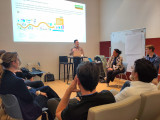
Op dinsdag 5 juli, organiseerde de werkgroep slimme energie systemen (SES) van de Provincie Noord-Holland, TenneT en Liander een digitale sessie voor de SES community. Hierin vertelde Liander over congestiemanagement 2.0 en gaf de Provincie inzicht in de aankomende subsidieregeling voor SES projecten.
Updates ontvangen van en/of meedoen aan de community? Mail naar cato.bechtold@hiemstraendevries.nl
Want to receive updates like this in your inbox?
Get notified about new updates, opportunities or events that match your interests.
Maybe you will also like these updates
Amsterdam and Haarlem launch groundbreaking sustainable artificial turf pitch innovations

The pioneering innovations were presented of the Scale Up Future-proof artificial turf pitches project, a collaboration between Amsterdam and Haarlem focused on sustainable artificial turf pitches. Over the next few years, more than 250 sports pitches in both cities will be transformed into circular, energy-generating and climate-adaptive sports venues. These artificial turf pitches can not only generate and store energy, but also involve smart water management. An approach that is globally relevant for urban sports infrastructure.
Three consortia collaborate on the sport pitch of the future
The three selected consortia Antea Sport, EnergieVeld and GOO4iT together comprise more than 15 market players. They join forces within this innovation partnership, where there is room for long-term collaboration, co-creation and scalable innovation. The pioneering solutions will make it possible to cool down sport pitches on warm days, help dispose of and collect rainwater, make the pitches more pleasant for the users and possibly even generate energy for the surrounding area. Find out how these innovations are shaping the sport pitch of the future here.
Two municipalities: joint procurement
The Scale Up Future-proof artificial turf pitches project is a unique collaboration between two municipalities and market players. The municipalities jointly procure pooling their purchasing power and use an innovation partnership to challenge the market to test and scale up innovative and sustainable solutions. In doing so, the solutions are also scalable and transferable to other cities in the Netherlands and Europe.
From prototype to pilot fields
The first prototype fields will be constructed in Amsterdam and Haarlem in 2026, in different capacities and combining multiple innovations, where they will be extensively tested and monitored for a year. Successful concepts are then scaled up to full-scale pilot pitches and tested and monitored for another year. This will form the basis for the new standard of sustainable sports pitches, with potential for adoption in other cities around the world. At the same time, existing pitches are already being improved with the most sustainable solutions available, making an immediate impact from the start. The project thus shows how cooperation between municipalities and market players can lead to innovative, climate-proof sports infrastructure with international relevance.
Join us
This project provides cities worldwide a blueprint for sustainable, smart, and future-proof artificial turf pitches. Interested municipalities and industry partners can get in touch and subscribe to our news updates by sending an e-mail to: sportveldvandetoekomst@amsterdam.nl.
Cenex Webinar #2 - EV Chargers: How to know where to place them?

Join us for an exclusive webinar featuring three leading European cities sharing their proven strategies for EV charging infrastructure placement. Learn from real-world experiences and discover data-driven approaches that are transforming urban mobility across Europe.
𝗪𝗵𝗮𝘁 𝗬𝗼𝘂'𝗹𝗹 𝗟𝗲𝗮𝗿𝗻
🏙️ 𝗦𝘁𝗿𝗮𝘁𝗲𝗴𝗶𝗰 𝗣𝗹𝗮𝗰𝗲𝗺𝗲𝗻𝘁 𝗔𝗽𝗽𝗿𝗼𝗮𝗰𝗵𝗲𝘀 - Discover how Brighton & Hove, Oslo, and Metropolitan Region of Amsterdam Electric have developed their EV charging strategies
📊 𝗗𝗮𝘁𝗮-𝗗𝗿𝗶𝘃𝗲𝗻 𝗗𝗲𝗰𝗶𝘀𝗶𝗼𝗻 𝗠𝗮𝗸𝗶𝗻𝗴 - Learn about the tools and methodologies these cities use to optimize charging point locations
🚗 𝗦𝗲𝗿𝘃𝗶𝗻𝗴 𝗔𝗹𝗹 𝗥𝗲𝘀𝗶𝗱𝗲𝗻𝘁𝘀 - Understand how to address the needs of residents without private parking spaces
🌍 𝗜𝗻𝘁𝗲𝗿𝗻𝗮𝘁𝗶𝗼𝗻𝗮𝗹 𝗕𝗲𝘀𝘁 𝗣𝗿𝗮𝗰𝘁𝗶𝗰𝗲𝘀 - Gain insights from three different countries and municipal perspectives
💡 𝗟𝗲𝘀𝘀𝗼𝗻𝘀 𝗟𝗲𝗮𝗿𝗻𝗲𝗱 - Avoid common pitfalls and learn from real implementation experiences
𝗙𝗲𝗮𝘁𝘂𝗿𝗲𝗱 𝗦𝗽𝗲𝗮𝗸𝗲𝗿𝘀
Kieran Fitsall - Brighton & Hove Council
Sture Portvik & Sara Teige Kalsaas - City of Oslo
Annekee de Jager - MRA-e (Amsterdam Metropolitan Region)
Hosted by Sanne van Breukelen - Cenex Nederland
𝗪𝗵𝘆 𝗔𝘁𝘁𝗲𝗻𝗱?
With Europe requiring 6.8 million public charging points by 2030, municipalities face unprecedented challenges in planning and implementing EV infrastructure. This webinar brings together three cities that have successfully navigated these challenges, offering practical insights for:
- Municipal planning departments
- Urban mobility professionals
- EV infrastructure developers
- Policy makers and city officials
- Transport consultants
𝗞𝗲𝘆 𝗧𝗼𝗽𝗶𝗰𝘀 𝗖𝗼𝘃𝗲𝗿𝗲𝗱
- Historical approaches vs. modern data-driven strategies
- Stakeholder engagement
- Grid capacity considerations and smart charging integration
- On-street charging solutions for urban residents
𝗪𝗵𝗼 𝗦𝗵𝗼𝘂𝗹𝗱 𝗔𝘁𝘁𝗲𝗻𝗱
This webinar is essential for anyone involved in:
- Urban planning and development
- Sustainable transport initiatives
- EV infrastructure deployment
- Municipal policy development
- European mobility strategy
𝗥𝗲𝗴𝗶𝘀𝘁𝗿𝗮𝘁𝗶𝗼𝗻
Don't miss this opportunity to learn from Europe's leading cities in EV infrastructure planning. Register now to secure your spot and gain access to exclusive insights that could transform your city's approach to EV charging.
---
This webinar is part of Cenex's ongoing commitment to accelerating the transition to sustainable transport through knowledge sharing and best practice dissemination across European cities.
Demoday #28: How to keep our mechanics on the move?

On the 5th of July, during Demoday #28, we zoomed in on one of the pressing challenges facing the energy transition: grid congestion, and more specifically, how to keep the people who maintain the grid moving efficiently.
Grid congestion is a serious and growing concern for grid operator Alliander. It is therefore essential to speed up the grid reinforcement as much as possible. Alliander’s Operation 2.0 team is exploring innovative ways to work smarter, faster, and more flexibly to keep pace with these developments.
Their efforts focus on three tracks:
• Alleviating staff shortages by training office employees to occasionally support fieldwork.
• Exploring technologies like advanced ground radar to get better insights into underground assets.
• Improving the logistics of supplying mechanics to ensure they have the right tools, in the right place, at the right time.
This last track was the main focus of our work session.
Inefficient supply of mechanics
Logistics experiences show that mechanics collect materials inefficiently when supplying their vans and jobs, resulting in stock corrections, less control over stock, unnecessary work for logistics staff, and valuable mechanic hours being lost, which leads to less execution work. A few key problems stood out:
• Supplies are scanned inconsistently, so the system doesn’t reflect what is actually in stock.
• Every van is different, with a custom layout that suits the preferences of its mechanic.
• The work itself is unpredictable, which makes standardised restocking difficult.
• With a transition to smaller electric vans, space is becoming even more limited.
A simple optimisation of the process is not enough, especially without considering the human element. For many mechanics, a visit to the supply centre is more than just logistics. It is a moment of connection, a short break from the road, or simply a chance for a good coffee.
Ideas from the network
In groups of four, we brainstormed creative ideas to improve the supply of Alliander vans while keeping the needs and routines of mechanics in mind.
Some highlights:
• Peer-to-peer van inspiration: Let mechanics share the layout of their vans with colleagues. They can exchange best practices and take pride in an efficient setup. Adding a bit of gamification might boost motivation even more.
• A mobile supply service: A supply van could drive around to restock mechanic vans, reducing the need to visit the supply centre. However, this might remove the social element of taking a break with colleagues.
• Smarter routing: Track the location of mechanics only in relation to nearby grid faults. This way, the closest available mechanic can respond without feeling like their movements are constantly being monitored.
• Package-based resupply: Inspired by delivery service Picnic, mechanics could exchange complete “supply packages” instead of picking out materials individually. Collaborating with wholesale suppliers could reveal more useful insights.
• Automatic stock tracking: Tag all materials with RFID chips and use sensors installed in the door of the van to register what is removed from the van. This eliminates the need for manual scanning and reduces the chance of mistakes.
Do you have a bright idea to improve how mechanics work? Let us know in the comments or send a message to Noor at noor@amsterdaminchange.com.
A big thank you to Thomas Hoekstra and Iris van der Zanden from Alliander for bringing this challenge to the network, and to Chantal Inia from Royal HaskoningDHV for moderating the session.