Stay in the know on all smart updates of your favorite topics.
David Bosch,
Communication Consultant
at Gemeente Amsterdam,
posted
Whitepaper Shared Mobility Employers (Dutch)
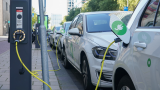
Due to the many working from home, employers are moving away from fixed travel allowances on a large scale and business lease fleets are also shrinking for the first time in years. In order to meet the travel needs of employees in a good way, more employers are switching to shared mobility as a financial solution.
By focusing on shared mobility, you save valuable parking space, offer your employees a flexible mobility solution and possibly save on your CO2 emissions. Research by the Kennisinstituut Mobiliteit (KiM) shows that a car sharer annually emits 175 to 265 kg less CO2 than before he started car sharing. In addition, shared mobility contributes to better accessibility of the region. Shared mobility is therefore booming: in 2020 the number of shared car users rose by no less than 42% to 730,000.
Municipality of Amsterdam is investing heavily in shared mobility
The City of Amsterdam is working hard to make shared mobility a fully-fledged alternative for everyone who wants to move around in the city. Shared mobility is one of the solutions to keep mobility, quality of life, space on the street and accessibility in the city in balance. There are experiments with shared bicycles and scooters on the street and providers of shared cars are encouraged to offer their services in Amsterdam.
Breikers supports employers free of charge in the Amsterdam Metropolitan Area
The mobility needs of every company and every employee are different. That is why Breikers provides free and independent tailor-made advice. Our interactive mobility scan is even free to use for Breikers participants! Do you need help developing your plans for the realization? In many cases you can re-enable Breikers to come up with the right solution.
To help you on your way, a white paper (in Dutch) has been prepared with the most up-to-date ins-and-outs in the field of Shared Mobility.
David Bosch,
Communication Consultant
at Gemeente Amsterdam,
posted
16% car owners considering replacing car with shared transport

Amsterdammers are a lot more positive about shared transport than day trippers and commuters, and cost savings are seen as the biggest advantage. It also appears that many Amsterdammers have old assumptions with regard to availability and costs. The municipality of Amsterdam has therefore launched a campaign to draw attention to the many advantages of shared transport.
Research
The municipality of Amsterdam has commissioned a survey among Amsterdammers, day trippers and commuters. It is clear that Amsterdammers are much more positive about shared transport (49%), than day trippers (36%) and commuters (32%). No less than 16% are considering replacing their car with shared transport. Cost savings (39%), convenience (25%) and environmental benefits (19%) are the main advantages of shared transport. The arrival of mobility hubs, MaaS (mobility as a service) apps and more insight into current car costs are also reasons to opt for shared transport.
Campaign
The campaign makes it clear to the Amsterdammer that there are many advantages when it comes to shared transport. Do you drive less than 10,000 kilometers per year? Then a shared car is quickly cheaper. And it also results in a lot less hassle. In addition, there is the freedom of choice from a wide range of bicycles, scooters and cars, better accessibility in the city and cleaner air because much of the shared transport is electric. But also more space on the street, because if we share bicycles, scooters and cars with each other, fewer means of transport are needed.
Availability significantly increased
In the past year, the supply of shared transport in the city has increased considerably. The number of shared cars in public space has risen from 1,250 to almost 2000 and it is expected that hundreds more shared cars will be added this year. In addition, you can choose daily from about 750 shared cars of Amsterdammers who share their own car. Since last summer, 700 shared scooters have been driving through the city as an experiment and from 15 June, also as part of an experiment, 1300 shared bicycles and 100 community cargo bikes will be added step by step.
Note from ASC: What are your thoughts on this? Let us know bellow.
Jasmyn Mazloum,
Communicatie
at Gemeente Almere,
posted
Almeerse basisschool De Verwondering meest duurzame project van Nederland!
Ecologische basisschool De Verwondering in Almere Hout heeft de Gouden Kikker gewonnen: de prijs voor het meest duurzame project van Nederland.
De jury van de Duurzaam Bouwen Awards vindt De Verwondering een inspirerend voorbeeld van duurzaam maatschappelijk vastgoed op zeer hoog niveau én in de breedste zin van het woord. Niet alleen door de keuze van natuurlijke materialen, systemen en bouwmethoden, maar ook door de ontwerpfilosofie. Het natuurinclusieve schoolplein is een ecosysteem op zich, met nestgelegenheden voor vogels en insecten, lokale flora en een kleine baai. De leerlingen zien zelf hoe hun school is gebouwd, welke materialen zijn toegepast en hoe het van energie wordt voorzien.
Met dit alles, is het project niet alleen een inspiratie voor de leerlingen én medewerkers van de school, maar ook voor de rest van Nederland!
Esther 't Hoen, jurylid en projectleider circulaire bouweconomie van het ministerie van BZK, mocht de award aan de architect, Daan Bruggink van ORGA architect overhandigen. “De samenwerking tussen de Gemeente Almere en Stichting Prisma Almere, de opdrachtgevers en Paula van Kuijk, de directrice van de school en de installateur, heeft geleid tot dit resultaat.”
We zijn trots op het project en uiteraard op de samenwerking tussen de verschillende partijen wat heeft geleid tot een prachtig resultaat. Mooi dat dit, mede dankzij de Gouden Kikker van de Nederlandse Duurzaam Bouwen Awards, nationaal de aandacht krijgt. De awards worden mede mogelijk gemaakt door abcnova, Stichting W/E adviseurs duurzaam bouwen, FSC Nederland en Duurzaam Gebouwd.
Verder hebben meegewerkt aan De Verwondering: Bladgroen, Van Norel bouwgroep, Lüning Ingenieurs in houtconstructies, Nieman Groep, TDS Engineering, Projectum Inrichten B.V., GoedGeplant en uiteraard iedereen bij De Verwondering!
Roel van der Heijden,
Technology, physics and astronomy editor of NEMO Kennislink.
at NEMO Kennislink,
posted
Vervoer in 2050: zo duurzaam mogelijk

Gaan we straks met de hyperloop op vakantie, stappen we in een personendrone, of is de (elektrische) fiets hét vervoersmiddel van de toekomst? In vier artikelen zoekt NEMO Kennislink-redacteur Roel van der Heijden op welke transportmanieren we moeten inzetten. Sparen we het milieu of willen we zo snel mogelijk overal ter wereld zijn? Sommige keuzes gaan ten koste van elkaar, maar niet altijd. We definiëren steeds een nieuwe einddoel. Het eerste deel is: hoe maken we vervoer zo duurzaam mogelijk?
De (elektrische) fiets is in dit toekomstscenario doorgebroken als hét vervoersmiddel voor alle afstanden onder de pakweg twintig kilometer. Hij blijkt niet te verslaan als het om duurzaamheid gaat. Ga je iets verder dan pak je de elektrische auto of trein. Voor de echt lange reizen gebruiken mensen het vliegtuig op grotendeels synthetische brandstoffen uit duurzame stroom.
Klinkt dit scenario verrassend ‘gewoon’? De fiets, de auto en het vliegtuig als de vervoersmiddelen van de toekomst? Waar zijn de drones en hyperloops? Uit een rondgang van NEMO Kennislink bij een aantal duurzaamheids- en vervoersonderzoekers blijkt dat we het daar wat betreft duurzaamheid niet van moeten hebben.
Lees het artikel hier. In vervolgdelen nemen we op een vergelijkbare manier de snelheid, betaalbaarheid en het delen van vervoer onder de loep.
(foto Petar Milošević via CC BY-SA 4.0)
Karin Sijbring,
posted
MaaS app Amaze Mobility is live!

The idea behind MaaS (Mobility as a Service) is to give you an overview of all the public transport and shared mobility options an area has to offer. Instead of owning transport, you're just paying for the use of transport which makes streets less crowded and air cleaner. It wouldn't be 2021 if it didn't come with an easy to use app. But how easy is it really?
You no longer need a OV-Chipkaart. With the Amaze Mobility app you can plan, pay and travel with public transport or shared mobility. You can use different shared mobility with one account, so choose the tram today and a shared bike tomorrow. And since the app makes it easy to manage and share travel expenses, just say goodbye to bulky declarations.
Want to give the Amaze Mobility app a try?
Let’s change the way we travel and improve the liveability in cities as we go. We are still looking for companies that want to partner with us to test and spread the app.
Note from ASC: Like to know more or do you have a tip? Let Karin know in the comments.
Liza Verheijke,
Community Manager
at Amsterdam University of Applied Sciences,
posted
Who should win the Dutch Applied AI Award?

Last year, during the Month of the AAI in November, the Centre of Expertise Applied Artificial Intelligence (AUAS - Amsterdam University of Applied Sciences) presented the Dutch Applied AI Award for the first time. This year we are back for a second edition. The award is part of the Computable Awards and is for suppliers of AI solutions, start-ups in the AI field and good examples of the implementation of AI.
This award is jointly organized with AUAS, Computable and podcast De Dataloog . You can nominate an individual or organisation, based on a project you think has stood out in the past 12 months. The projects may have been particularly successful, innovative or extensive.
You can nominate until 16 August 2021
The winner will be announced on 2 November 2021 during a spectacular show in the Jaarbeurs Utrecht. Last year, healthcare platform DEARhealth won the Dutch Applied AI award. Who will walk away with the prize this year? 🙌🏻
About the Computable Awards
This will be the 16th year in a row that Computable will present the Computable Awards in November 2021. These prizes are awarded to companies, projects and individuals who, according to Computable readers, have clearly distinguished themselves in the past year.
An independent jury of experts will select five nominees for each award from the nominated parties. The ranking by the jury and the number of votes from Computable readers each determine half of which nominee will receive the award in November. The number of times a party is nominated for a nomination does not play a role, but the quality of the substantiation and information about the project mentioned does.
Liza Verheijke,
Community Manager
at Amsterdam University of Applied Sciences,
posted
Comenius Leadership Fellow grant to make AUAS students AI-ready

The Centre of Expertise Applied AI of the Amsterdam University of Applied Sciences (AUAS) has been awarded a Comenius Leadership Fellow grant of €500,000 for the AI4Students project. Over the next three years, the project headed by Professor of Responsible AI Nanda Piersma intends to use the Comenius grant to equip AUAS students for a future in which artificial intelligence (AI) will play an increasingly important role.
The assessment committee of the Netherlands Initiative for Education Research (NRO) selected the project from a total of 15 applications and praised AI4Students for its innovative character and the expected benefits for students, lecturers and the professional field. “Because of the social relevance of the topic, the committee is confident that the outcomes will be valuable to students and lecturers as well as the professional field.”
AI-ready upon graduation
AI4Students is a project that should have an impact in all faculties of the Amsterdam University of Applied Sciences. “We would like to ensure that all AUAS students are AI-ready by the time they graduate, not just with a general acquaintance with AI, but AI specifically geared to their field of study,” Piersma explains. “So it’s not about them studying with us first to become an accountant or physiotherapist, for example, and then having to take an additional training course as soon as they start their job. Instead, they should already be thinking with us about how AI is going to affect their job.”
The Comenius Leadership Fellow 2021 grant will enable Piersma to start fulfilling that ambition over the next three years. “What we want to do is start performing an AI impact scan for 9 degree programmes,” Piersma explains. “In what way is artificial intelligence going to impact a professional field? How will this affect what professionals need to be able to do, and what does that mean for the degree programme itself?”
Herman van den Bosch,
professor in management development
,
posted
Tools for circular construction
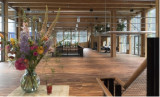
The impact of circular principles on the construction sector will be large and beneficial because buildings are responsible for more than 50% of the total use of materials on earth, including valuable specimen such as steel, copper, aluminium and zinc.
The picture above – the interior of the Circle pavilion of the ABN-AMRO bank in Amsterdam is an example of a new building that uses as many existing components as possible and new components of the building are designed to be reused. Think of:
• 1200 m2 of wooden floors
• Partition walls of a demolished building
• 16.000 garments of employees for isolation purposes
By circular construction we mean designing, building and demolishing a building in such a way that, in addition to the high-quality reuse of materials, justice is done to sustainability ambitions in the field of energy, water, and biodiversity and ecosystems.
New materials are often more expensive than new ones
In case of demolishment, nowadays many components are already reused, but at a very low level, for instance concrete and stones as the foundation of new roads. Apart from the limited necessity to construct many new roads, this type of recycling destroys the intrinsic quality of materials and does not diminish the use of new materials. The biggest problem is that recycled materials are often more expensive than new ones.
Evidently, progress can be made by planning, designing, developing, and building circular buildings. A number of options are mentioned below.
Dedicated urban planning
Challenges for planning are the use of inner-city vacant land and issuing mandatory requirements regarding the construction of new buildings, for instance the use of less cement, glass and steel, the mandatory application of a certain percentage of reused materials, and becoming energy positive or at least energy-neutral. Switching to sustainable timber is an option for 90% of homes and 70% of offices being built.
Mandatory reuse of existing components
Reuse of existing materials means that glass is reused as glass and concrete pillars as pillars. The same applies to doors, frames, carpets, wall-cladding materials and so on. To start with, after demolishment all materials must be selected, cleaned, registered, and stored in new-to-develop warehouses. A materials passport, which contains an overview of all materials and components that are used to construct of a house or building, is a useful tool as well. The obligation to reuse a large percentage of existing components has far-reaching consequences for the design and construction of new houses.
Industrial production and 3D printing
Construction of components in factories, deploying industrial processes, will reduce costs by 30 percent and the delivery time by at least 50 percent. In 2014, the Chinese company WinSun printed and assembled ten houses, each 195 square meters, in 24 hours, for an amount of €5,000 per house[1]. The company used 30 - 60 percent less material than in traditional construction. The “ink” for their 3D printers is a mixture of dry cement and construction waste. WinSun plans to open 100 recycling plants in China to convert waste into cost-efficient ink. This video below demonstrates the printing activities of WinSun
Sharing space
The size of apartments will decrease, partly due to costs, but also because of the presence of shared guest rooms, lounge areas and terraces for working and socializing, spaces for washing and drying laundry. The need for office space will decrease rapidly due to sharing space and working home. Already now, IBM has only one desk available for 12 employees. Given the presence of 300,000 employees, this has led worldwide to savings on real estate of around € 1 billion in the past 10 years.
Modularity and durability
A key barrier for better use of floor space is the lack of flexibility in the design of buildings and room configurations. A modular design, which provides for easy replacement of partitions and placement of complete pre-fab units (kitchens and bathrooms, walls, and roofs as well) facilitates adjustments in case of new construction or as the use of a building changes. DIRTT builds interior components that are modular and standardized and offer maximum interchangeability in both existing and new buildings[2]. This video gives an impression of the production and application of these flexible and inexpensive solutions.
Forget new construction at all
Anyway, a first step is more efficient use of existing buildings and houses.
As families become smaller and offices need less space, existing space becomes underused. Many thousands of one family houses can be transformed in apartments. Well-thought adjustments to the lay-out of existing houses and buildings can improve their efficiency without reducing their functionality and amenity. Look here for inspiring examples.
I will regularly share with you ‘snapshots’ of the challenge to bring social and ecological sustainable cities closer using technology if helpful. These posts represent findings, updates, and supplements of my e-book Humane cities. Always humane. Smart if helpful. The English version of this book can be downloaded for free below.
Note from ASC: What are your thoughts on this? Let Herman know bellow.
Anonymous
posted
DevOps Engineering

Helo! I am a Computing student at the Federal Institute of Education, Science and Technology.
I wonder if you would like to partner to create a DevOps Engineering company.
Code, communication, monitor, deployment, planning, infrastructure, networks.
I'm an entrepreneur and DevOps developer.
Send an email to create a DevOps project to leonardovieira21@hotmail.com
Menno Rubbens,
Director
,
posted
The building for the Temporary Courthouse in Amsterdam will be relocated to Enschede!
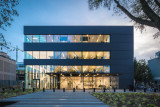
Over the coming months, the building of the Temporary Courthouse Amsterdam will be dismantled and completely reassembled on 'Kennispark Twente' (the area of Business & Science Park/Campus UT) in Enschede. There, it will have a new function as an office and research facility.
The temporary accommodation provided the Amsterdam judiciary continuity during the construction of the new permanent court. Now that this new home has been completed, the building will move as planned. At the time, the Central Government Real Estate Agency (RVB) tendered the assignment as a Design, Build, Maintain & Remove contract, which was realized by dpcp, a cooperation between cepezedprojects and Du Prie Bouw & Ontwikkeling. cepezed and cepezedinterior designed the building and Du Prie took care of the execution.
National Sustainability Award Steel after completion
Importantly because of its high degree of circularity, it won both the Amsterdam Architecture Prize (Golden AAP) and the National Sustainability Award Steel after completion. Also, in the report 'Circular Buildings – a measurement method for detachability' it scores the highest of all tested projects. The demountable construction and floors, which cepezed designed in close collaboration with IMd Consulting Engineers, play an important role in this.
Dismantling and reassembly with a 3D model
Yesterday saw the handover of the key from the RVB to dpcp, which heralds the new phase of the building. For the relocation, dpcp called in the expertise and experience of Lagemaat from Heerde, a company with a solid background in the dismantling and reassembly of buildings. Through a unique coding based on the 3D model and a 3D scan, the precise position of each part is known. Smaller elements are transported in containers and larger ones, such as the walkway, are loaded directly onto trucks. Lagemaat processes materials that are not reused in other projects. A minimal amount will be recycled in a high-quality manner. The dismantling period starts today already. The building is expected to be taken into use by the Overijssel Restructuring Company in early 2022.
Note from ASC: Would you like to know more? Let Menno know in the comments.
Jasmyn Mazloum,
Communicatie
at Gemeente Almere,
posted
PODCAST Groen & Gezond Almere: Jim van der Wardt over ondernemen, verbinden en Makers van Almere
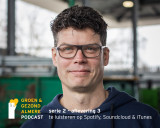
In deze aflevering spreekt presentatrice Nadia Zerouali Almeerder Jim van der Wardt. Hij zag een kans om een beweging in de stad die al bestond, maar nog niet zichtbaar was, een podium te geven. Onder de noemer Makers van Almere bracht hij de makers in de stad digitaal samen én bij de mensen thuis.
Zelf is hij ook een ondernemende maker in de stad en brengt met zijn duurzame uitgangspunt een oude ambacht weer tot leven. Hoe hij dit allemaal doet, ontdekken we in deze aflevering. Hij is te luisteren op Spotify, Apple Podcasts & Soundcloud!
Ben je nieuwsgierig naar wat er verder allemaal gebeurd op het gebied van duurzaamheid in Almere? Je kunt het duurzaamheidsprogramma van de gemeente Almere volgen via groenengezond.almere.nl of via Instagram, Facebook, Twitter en LinkedIn onder Groen en Gezond Almere.
Heb je nog ideeën voor deze podcast, een tip of iets aardigs? We horen heel graag van je. Laat een reactie achter via je favoriete podcast app of in de comments.
Amsterdam InChange,
Connector of opportunities
at Amsterdam InChange,
posted
Aiming for the Moon to Achieve 200 Intelligent & Climate Neutral Cities by 2030

On June 21, under the flag of RVO’s 100 Climate Neutral Cities Mission, Amsterdam Smart City hosted the 200 Intelligent & Climate Neutral Cities Jam, bringing together stakeholders of the 100 Intelligent Cities Challenge (ICC) and 100 Climate-Neutral Mission, to create synergies between these two initiatives and help amplify their impact. In this post we provide a short recap of the session.
To kick-off the session, participants were asked to reflect on what will it take to achieve the so-called “twin” green and digital transitions. Some of the key ingredients indicated by the participants were: strong leadership, sense of urgency, good policy, collaboration, innovative thinking, shared ambition, funds and imagination.
After that ASC program director Leonie van den Beuken introduced the work of Amsterdam Smart City, which started in 2009 with a focus on engaging citizens and entrepreneurs in small-scale projects that could accelerate the energy transition through digital and social innovations. Reflecting on the situation 12 years later, Leonie noted the work is far from finished: “The world is in transition and people often say everything is changing too fast. But the opposite is true; we are not changing fast enough”.
100 Intelligent Cities
Next, Dana Eleftheriadou, European Commissions’ Head of Advanced Technologies and Digital Transformation provided an introduction to the Intelligent Cities Challenge – a programme launched in 2020 that is helping more than 100 small and medium European cities on their way to sustainable growth through the use of digital technologies. The programme is delivering tailored strategies and boosting capacity of municipal authorities and their innovation ecosystems on five themes: citizen participation & digitalization of public administration, green economy & local green deals, upskilling & reskilling, green & digital transition in tourism, and supply chains, logistics and the economics of mobility.
100 Climate Neutral Cities
The following pitch came from Harry Tuinder, representative of the Directorate General for Research and Innovation at the European Commission, who introduced the Climate Neutral Cities Mission which aims to achieve at least 100 climate-neutral European cities by 2030, and ensure that all European cities build the right foundation to become climate-neutral by 2050. The programme will be one of five missions inspired by the Apollo 11 programme that sent the first man on the moon. The idea is to create bold yet realistic targets to address key societal challenges by inspiring bottom-up innovation and solutions. The mission is expected to be published in October 2021.
The session wrapped up with short contributions by Christiaan Norde, Policy Advisor International Affairs at the City of Amsterdam and Jacobine de Zwaan, Smart City Advisor at Ministry of External Affairs, who reflected on the role of learning in city networks and public-private collaboration to achieve climate-neutral and smart cities.
The Intelligent Cities Challenge and Climate Neutral Cities Mission are inspiring examples of how the European Commission is mobilizing resources to accelerate the twin green and digital transitions. As Mariana Mazzucato, special adviser on research and innovation for the Commission points out, the collaborative, mission-oriented thinking resulted in putting a man on the moon. We can use the same approach to solve our most “wicked” problems – including climate change – closer to home and improving the lives of all Europeans.
Check out the recording of the event below.
Isabelle van der Poel,
projectmedewerker communicatie
at De Gezonde Stad,
posted
Circulaire fashion wordt het nieuwe normaal!

We leven in een tijdperk van 'fast fashion', waarin we vallen van de ene trend in de andere. We dragen een paar keer dat toffe jasje, waarna deze onderin de kast verdwijnt of zelfs wordt weggegooid. Monique Drent pakt deze symbolische 'klerezooi' aan met The Swapshop. In deze winkel lever je jouw kleding in, en kun je met je verdiende punten of 'swaps' weer een tweedehands outfit scoren!
Ik de Swapshop kun je jouw kleding inleveren en hier krijg je punten voor. In de winkel kun je met deze zogeheten ‘swaps’ en een klein bedrag aan servicekosten een ‘nieuwe’ tweedehands outfit scoren.
‘Je draagt bij aan het verkleinen van de afvalberg, je verlengt de levensduur en je hoeft minder te produceren. Het is win-win-win!'
Lees in ons interview met Monique wat zij doet voor een duurzaam Amsterdam en welke mooie samenwerkingen zij opzoekt!💚
Note van ASC: Wil je nog net iets meer weten? Laat het weten in de comments.
Cornelia Dinca,
International Liaison
at Amsterdam InChange,
posted
City Deal “Smart City, This is How You Do It” Connects to International Best Practices
How can we learn from international smart city experiences to ensure that we do not keep reinventing the smart city wheel. In the City Deal “A Smart City, This Is How You Do It” 58 public and private parties are working together to collect, validate and scale smart city solutions in the Netherlands.
On 10 June, Future City Foundation (FCF) and Amsterdam Smart City (ASC) brought together more than 30 Dutch and international colleagues to connect the City Deal to international experiences and best practices. The session consisted of short pitches sharing the tools and solutions developed in the City Deal Working Groups. For every pitch the international experts were asked to share their experience with similar projects, and reflect on what is needed to improve and scale the solutions abroad.
1. Open Urban Data Platform Tender
As more municipalities look to purchase urban data platforms, can we develop a generalized Program of Requirements? The Dutch cities of Rotterdam, Hilversum, and Helmond are working to develop such a flexible Program of Requirements, taking into account aspects such as scalability, flexibility and shareability of data, as well as privacy, cybersecurity, and data autonomy. During the session, the city of Aahus shared the experience of Open Data DK, a collaboration of Danish municipalities and regions to not only tender, but collectively develop an open data portal, leading to improved collaboration and cost savings for Danish municipalities and their stakeholders.
2. Model ByLaw Smart City in Public Space:
The public space is rapidly digitalization with many parties wishing to add sensors, beacons, cameras and other objects to enable various smart city applications. Local authorities need to find effective ways to regulate how this is done, so that the public space does not become a “Wild West” of smart applications. Within the City Deal, a model bylaw has been drawn and it is now being tested in Rotterdam. The question to the group was whether similar bylaws or initiatives been developed in other cities or jurisdictions? The city of Vienna shared its experience developing a Smart City Framework Strategy – a high level but binding document when it comes to designing bylaws related to various smart city domains.
3. Citizen Measurement Initiatives:
Within the City Deal three Working Groups are exploring how to use citizen measurement to create smart, sustainable, and inclusive cities, and how to link these initiatives to policy. On this topic the group could learn from initiative like iScape and WeCount in Dublin’s Smart Docklands District, which focus on engaging citizens in measurement projects, and linking the results to city policy. And when it comes to engaging citizens in measuring their environment, city of Dublin had another suggestions for the Dutch colleagues: leverage the existing network of public libraries to engage and involve citizens and policy makers in citizen-measurement projects.
Second International Roundtable Planned
The discussion revealed there are a lot of shared challenges, for instance in scaling smart city projects, so it's necessary that we keep sharing approaches and lessons learned internationally. Following the success of this first international roundtable, we are planning a second session on September 30. Dutch and international experts who would like to participate, can send an email to Cornelia Dinca via cornelia@amsterdamsmartcity.com with a short explanation of how like to contribute to the session. For more information or any other questions about the City Deal please contact Wendolijn Beukers via wendolijn@future-city.nl.
Thank You to the Participants
ASC and FCF would like to thank all the Dutch and international colleagues who contributed their expertise during the session.
City Deal Working Groups Members
· Noor van den Brink, Policy Advisor, Ministry of Infrastructure and Water Management
· Marcel Broekhaar, Smart City Program Management, City of Zwolle
· Arjan Hof, CTO, WeCity
· Daniel de Klein, Business Development Manager Digital City, City of Helmond
· Anita Nijboer, Partner, Kennedy Van de Laan
· Shahid Talib, Directeur Smart City, Heijmans
· Simone Rodenburg, Advisor CIO Office, City of Enschede
· Henri de Ruiter, Environmental Advisor, RIVM National Institute for Public Health and the Environment
· Jeroen Steenbakkers, Owner, Agaleo
International Peers
· Ulrich Ahle, CEO, FIWARE Foundation
· Jamie Cudden, Smart City Program Manager, City of Dublin
· Bo Fristed, CIO, City of Aahus
· Gianluca Galletto, Managing Director, Global Futures Group
· Lea Hemetsberger, Director Projects & Network, Open & Agile Smart Cities (OASC)
· Jong-Sung Hwang, Masterplanner Busan Smart City, South Korea
· Nigel Jacob, Co-Founder New Urban Mechanics, City of Boston
· Gabriella Gomez-Mont, Former Director of Laboratorio para la Ciudad, Mexico City & Founder of Experimentalista
· Jonathan Reichental, Former CIO of Palo Alto & author of Smart Cities for Dummies
· Florian Wollen, Coordinator, Urban Innovation Vienna
Jo Weston,
posted
Seenons wint de Circular Innovation Award

Seenons heeft een duidelijke missie: mensen samenbrengen voor een wereld zonder restafval. Hoe ze dat doen? Ze hebben een platform ontwikkeld waar restafvalstromen van bedrijven aan circulaire verwerkers worden gekoppeld en vervolgens worden omgezet om tot nieuwe producten. Deze missie is nu beloond met een internationale prijs: The Circular Innovation Award!
Na meerdere rondes was het tijd voor een laatste pitch door een van de founders van Seenons, Joost Kamermans. Een paar highlights van de pitch waren:
- Seenons matcht jouw overbodige grondstoffen aan producenten die hier iets moois van kunnen maken
- We faciliteren fijnmazige inzameling door samen te werken met verschillende logistieke partijen
- We werken samen met zoveel mogelijk lokale verwerkers die hier nuttige producten van maken
- In het meest ideale geval kopen de ontdoeners deze circulaire producten weer terug, zodat de cirkel rond is
- Daarnaast maken we dit gehele proces steeds transparanter
- Zijn nu primair in de randstad actief, maar zullen snel gaan uitbreiden in Nederland en daarbuiten
Terwijl wij groeien neemt de afvalberg af
In de afgelopen maanden zijn we uitgebreid naar meerdere steden. De fijnmazige inzameling in Amsterdam, Utrecht, Den Haag en Eindhoven is operationeel. De software is een stuk verder ontwikkeld; met enkele klikken zijn bedrijven van hun restafval af. Het aantal partners op het gebied van inzameling en verwerking stijgt hard....en we hebben recent een investering opgehaald om onze technologie verder te ontwikkelen en meer circulaire reststromen te onderzoeken.
Op zoek naar ondernemingsverenigingen en gemeenten
We willen alle bedrijven die afval produceren bereiken. Mochten ze lid zijn van een ondernemersvereniging, dan is dat helemaal super. Zo kunnen we samen meer bereiken. Maar iedereen is welkom.. Op dit moment focussen wij ons - naast de traditionele reststromen - op de randstedelijke gebieden voor de stromen koffiedrab en sinaasappelschillen. Daarvoor komen wij ook graag met gemeenten in contact om gezamenlijk de inzameling op te pakken.
Restafval wordt zeep of orangecello
We vinden al onze circulaire verwerkers waste heroes, dus we hebben geen favoriet product. Al is Kusala wel een fantastisch voorbeeld van een verwerker die ‘over-de-datum’ olijfolie verwerkt tot mooie zepen. En Dik&Schil wordt veelvuldig gebruikt op de vrijdagmiddagborrel bij Seenons op kantoor.
De prijs is erkenning van onze visie over hoe je de wereld restafvalvrij kunt krijgen en dat we daarmee in stedelijk gebied ook nog een logistiek probleem oplossen. Ook biedt het ons de mogelijkheid om versneld op te schalen buiten Nederland. We kunnen samen met partijen al gaan kijken naar oplossingen en mogelijkheden. Alleen samen bereiken wij een wereld zonder restafvalvrij en daar hebben we iedereen hard bij nodig!
Lees meer over de projecten van Seenons.
Note van ASC: Heb je input of tips voor voor Seenons? Laat ze achter in de comments.
Claire Gersen,
Advisor Responsible Technology
at Province of Noord-Holland,
posted
Duurzaam, transparant en onafhankelijk: de nieuwe datastrategie van provincie Noord-Holland
Provincie Noord-Holland heeft in mei 2021 een nieuwe datastrategie in concept vastgesteld. De wereld verandert snel en de strategie uit 2018 sloot steeds minder aan bij de huidige ambities. Het streven is om datatechnologie in te zetten voor optimale resultaten van onze maatschappelijke opgaven.
Hierbij zijn drie elementen van belang. Als eerste ‘duurzaamheid’. Wij willen profiteren van digitalisering op een manier die zo min mogelijk ten koste gaat van natuurlijke hulpbronnen. Het tweede element is ‘transparantie’. Wij zien in transparantie de kans om te innoveren mét het vertrouwen van onze inwoners. Het laatste element is ‘data-soevereiniteit’. Wij zien het als onze verantwoordelijkheid om onze onafhankelijkheid zo veel mogelijk te borgen. En misschien nog wel belangrijker: óók de onafhankelijkheid van de inwoners van Noord-Holland.
Om deze stip op de horizon te bereiken hebben we vier doelstellingen opgesteld:
Doelstelling 1
In 2023 zijn wij beter dan nu in staat om met data de maatschappelijke resultaten van onze opgaven te beschrijven, verklaren, voorspellen of optimaliseren.
Met datatechnologie dragen we bij aan de maatschappelijke resultaten die wij voor onze opgaven willen bereiken. Die resultaten verschillen per opgave. Daarom zullen wij voor elke opgave de datapositie in kaart brengen, zo kunnen we tegemoetkomen aan de specifieke behoeften. Voor een aantal complexe deelopgaven starten we bijvoorbeeld een experiment, waarbij we de mogelijkheden van een ‘digital twin’ onderzoeken.
Doelstelling 2
In 2023 zijn de digitaliseringsbelangen van onze provincie adequaat behartigd op het niveau van de Europese Unie, de Rijksoverheid, de Tweede Kamer en de regio Amsterdam.
Digitalisering en AI vertegenwoordigen een steeds groter economisch en maatschappelijk belang. Zij hebben meer en meer politiek-bestuurlijke aandacht. Zowel op het niveau van de Europese Unie, de Rijksoverheid, de Tweede Kamer als de regio Amsterdam. Dat is relevant voor onze lobby.
Doelstelling 3
In 2023 is meer data van de provincie open en toegankelijk beschikbaar en weten de inwoners van Noord-Holland waar ze deze data kunnen vinden.
Open data is voor de provincie om twee redenen van belang. Allereerst draagt het bij aan transparantie, wat essentieel is voor het vertrouwen van onze inwoners. Daarnaast stelt open data externe partijen, bijvoorbeeld startups, in staat om applicaties te ontwikkelen. Hiervoor richten wij in 2021 een open dataregister in. En hebben wij in 2023 onze meest relevante open datasets gepubliceerd.
Doelstelling 4
In 2023 ervaren inwoners, bedrijven en onze partners dat wij inzet van data en datatechnologie afwegen tegen de Tada-waarden: inclusief, zeggenschap, menselijke maat, legitiem en gecontroleerd, open en transparant, van iedereen - voor iedereen.
We werken vóór onze inwoners en bedrijven. Dus zorgen we dat ons werk met data geen negatieve gevolgen voor hen heeft. Kortom: we gaan verantwoord om met data en datatechnologie. Om dit waar te maken experimenteren we in 2021-2023 met het toepassen van de Tada-waarden en werken we toe naar het publiceren van onze algoritmen in een register. Zo innoveert de provincie Noord-Holland mét het vertrouwen van haar inwoners en bedrijven.
Note van ASC: Wil je nog net iets meer weten? Laat het weten in de comments.
Eline Meijer,
Communication Specialist
,
posted
Metropolitan Mobility Podcast!

Chris Bruntlett (Dutch Cycling Embassy) and Geert Kloppenburg are looking back at the Celebrating Cycling Cities event and our interviews with mobility experts from all over the world! Listen to the best practices and who we would like to speak next: https://bit.ly/mobilitypod
Christiaan Elings,
Strategy & Collaboration for Sustainable Transitions
at Royal Haskoning,
posted
Gezonde stad: slim, samen en in samenhang

Een gezonde stad is vitaal, veerkrachtig en toekomstbestendig – zowel maatschappelijk als economisch. Maar vanzelf gaat het niet. De druk op de stad is groot en de situatie is urgent, want er moet veel en liefst tegelijk: meer woningen, minder lawaai, schonere lucht, minder hittestress, een lager energiegebruik. Dit lukt alleen als we het slim, samen en in samenhang doen.
En er is goed nieuws: al die transities scheppen niet alleen verplichtingen, maar ook geweldige mogelijkheden. Zo biedt data science kansen om tot goede plannen en oplossingen te komen, om deze te visualiseren en communiceren én om participatie en besluitvorming te organiseren. In bijgaand artikel uit Binnenlands Bestuur geeft mijn collega Jan de Wit een overzicht van kansen.
Audrie van Veen,
Director Strategic Partnerships
at Amsterdam Economic Board,
posted
Regional Green Deals presented at EU 100 Intelligent Cities Challenge and EU Blueprint for Local Green Deals published
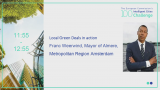
The Regional Green Deals of the Metropolitan Region Amsterdam were presented by Frank Weerwind, Mayor of Almere at the Mayor’s Summit of the 100 Intelligent Cities Challenge. Together with the Amsterdam Economic Board and Amsterdam Smart City, the Metropolitan Regio Amsterdam acts as a mentor region for the 100 European cities who participate in the challenge to work together on their ambitions for the digital and green transition.
For cities that want to work with their stakeholders on ambitious green deals the European Commission now published a practical guide titled Local Green Deals, A Blueprint for Action.
Find the speech by Mayor Weerwind below
22 June 2022
Honorable guests, ladies and gentlemen,
It is a great pleasure and honor to me to be invited to the Mayors’ Summit of the 100 Intelligent Cities Challenge, and I am very excited to share with you some of my thoughts on the green and digital – or twin – transition in the cities and regions of Europe. I also would like to express my gratitude to the European Commission and the Committee of the Regions for organizing this event on Green Deals and for launching the 100 Intelligent Cities Challenge. By doing this, you recognize the power of cities in the twin transition, you see the need for support for cities to make this transition happen and by this programme, you facilitate the network that cities can create.
My own city is Almere, a new town near Amsterdam and just 45 years old: it was created from scratch on reclaimed land from the sea, and is now a vibrant city with over 215.000 inhabitants. It is a city without ancient history and traditions, but a young city with a strong pioneering spirit, where there is space to experiment and to test innovative solutions in living labs. Our living lab approach has resulted in various circular and sustainable energy innovations in the city, for example: a smart thermal grid for the new Hortus neighborhood. The living lab approach has also led to the choice for Almere as the location for the World Expo on Horticulture in 2022, the Floriade, which will showcase innovations on greening, feeding, healthying and energizing cities, under the umbrella off Growing Green Cities. The twin transition is evidently a core aspect in this event. I will take this opportunity to invite you all to visit the expo next year in Almere.
But this morning I represent not only Almere but the Metropolitan Region Amsterdam, a region consisting of 32 municipalities and two provinces. An economically strong region in Europe with a high quality of life, an international hub with a huge amount of talent, knowledge, innovation and businesses. The Metropolitan Region Amsterdam is one of the so-called mentors in this programme, because we believe in sharing our vision with other cities in terms of knowledge and innovation, but, please, let me assure you that our ‘success’ story has been established, due to knowledge and innovation coming from the cooperation between cities. My aim for now is to continue the dialogue with you on the issues that we are sharing together.
As many of your regions, our region, with an economy highly defined by tourism and services industries, was hit hard by COVID-19. Therefore, we decided at an early stage to investigate, together with knowledge institutions and the business sector, how we could aim for green recovery. We felt more was needed, besides the required regional energy strategies, investing in our energy backbones, which nowadays also include a hydrogen-infrastructure, and ongoing European energy transition projects such as Atelier. We asked the Amsterdam Economic Board to organise this investigation, since they act independently and aim for connecting the companies, research and education institutes and governments in our region. Facing such an unprecedented crisis, we did not want to do this as governments alone, but together with all relevant stakeholders. And, my fellow Mayors, that is a lesson I want to share with you: don’t do it alone.
Based on interactive stakeholder sessions and scenario-planning, we started a trajectory towards green recovery, resulting so far in 3 Regional Green Deals and with these deals, extra focus on skills for sustainable jobs. The Green Deals are: making the textile value chain circular, developing the region as a innovative bicycle hotspot and -for the Netherlands this is really innovative- increase the amount of new-build houses in timber to 20% of the total of new residential building activity.
As a result of those Local Green Deals, we invest faster and more effectively in the economy of today and tomorrow. The aim is to anticipate on changing jobs and the necessary skills, to fill existing and future vacancies and to achieve greater well-being and prosperity in the long term. And that is what we wish for the whole of the European Union.
To conclude, I would like to compliment you with your efforts in the 100 Intelligent Cities Challenge. And please feel free to take a closer look into the work of the Metropolitan Region Amsterdam and to learn, copy the elements that would benefit you, but also to bring your knowledge to us, for example via our online platform Amsterdam Smart City. That way, together we advance in the European twin transition. And move forward to the digital, inclusive and sustainable future of our cities.
Herman van den Bosch,
professor in management development
,
posted
Beyond the smart city: Digital innovation for the Good of citizens

About ten years ago, technology companies started to provide cities with technology, luring them with the predicate ‘smart(er)’, a registered trademark of IBM. At that time Cisco's vice-president of strategy Inder Sidhudescribed the company’s ‘smart city play’ as its biggest opportunity, a 39,5 billion dollar-market. During the years, that followed, the prospects rocketed: The consultancy firm Frost and Sullivan estimated the global smart city technology market to be worth $1.56 trillion by 2020.
The persistent policy of technology companies to suggest a tight link between technology and the wellbeing of the citizens, angers me. Every euro these companies are chasing at, is citizens’ tax money. What has been accomplished until now is disappointing, as I documented in the IET Journal. According to The Economist it is not surprising that a ‘techlash’ is underway: Many have had it with the monopolistic dominance of behemoths like Google, Amazon, Facebook and the like, because of their treatment of sensitive data, the lack of transparency and accountability of algorithm-based decision making and the huge profits they make from it.
Regaining public control
However, let's not throw out the baby with the bathwater and see how digital innovation can be harnessed for the Good of all citizens. Regaining public control demands four institutional actions at city level.
1. Practicing governance
Before even thinking about digitalization, a city must convert into best practices of governance. Governance goes beyond elections and enforcing the law. An essential characteristic is that all citizens can trust that government represents their will and protects their interests. Therefore, it is necessary to go beyond formal democratic procedures and contact stakeholders directly, enable forms of participatory budgeting and deploy deliberative polling.
Aligning views of political parties and needs and wants of citizens takes time and a lot of effort. The outcome might be a common vision on the solution of a city’s problems and the realisation of its ambitions, and a consecutive political agenda including the use of tools, digital ones included.
2. Strengthening executive governmental power
Lack of cooperation within the departmental urban organizations prevents not only an adequate diagnosis of urban problems but also the establishment of a comprehensive package of policy instruments, including legislation, infrastructure, communication, finance and technology. Instead, decisions are made from within individual silos, resulting in fragmented and ineffective policies. Required is a problem-oriented organization instead of a departmental one and a mayor that oversees the internal coherence of the policy.
3. Level playing field with technology companies
Cities must increase their knowledge in the field of digitization, artificial intelligence in particular. Besides, but they should only work with companies that comply with ethical codes as formulated in the comprehensivemanual, Ethically Aligned Design: A Vision for Prioritizing Human Well-being with Autonomous and Intelligent Systems, drafted by the influential Institute of Electric and Electronic Engineers (IEEE)
Expertise at city level must come from a Chief Technology Officer who aligns technological knowledge with insight in urban problems and will discuss with company representatives on equal foot. Digitalisation must be part of all policy areas, therefore delegating responsibility to one alderman is a bad idea. Moreover, an alderman is not an adequate discussion partner for tech companies.
4. Approving and supporting local initiatives
Decentralization of decision-making and delegating responsibility for the execution of parts of the policy to citizen’s groups or other stakeholders helps to become a thriving city. Groups of citizens, start-ups or other local companies can invoke the right of challenge and might compete with established companies or organizations.
In summary: steps towards seamless integration of digitalization in citizen-orientated policy
1. Define together with citizens a vision on the development of the city, based on a few central goals such as sustainable prosperity, inclusive growth, humanity or - simply - happiness.
2. Make an inventory of what citizens and other stakeholders feel as the most urgent issues (problems and ambitions).
3. Find out how these issues are related and rephrase them if desirable.
4. Deepen insight in these issues, based on available data and data to be collected by experts or citizens themselves.
5. Assess ways to address these issues, their pros and cons and how they align with the already formulated vision.
6. Make sure that digital technology has been explored as part of the collected solutions.
7. Investigate which legal, organizational, personnel and financial barriers may arise in the application of potential solutions and how to address them.
8. Investigate undesired effects of digital techniques, in particular long-term dependence ('lock-in') on commercial parties.
9. Formulate clear actions within the defined directions for dealing with the issues to be addressed. Involve as many expert fellow citizens as possible in this.
10. Make a timetable, calculate costs, and indicate when realization of the stated goals should be observable.
11. Involve citizens, non-governmental and other organizations in the implementation of the actions and make agreements about this.
12. At all stages of the process, seek support from those who are directly involved and the elected democratic bodies.
13. Act with full openness to all citizens.
I can't agree more than with the words of Léan Doody (smart city expert Arup Group): I don't necessarily think 'smart' is something to strive for in itself. Unlike sustainability or resilience, 'smart' is not a normative concept…. The technology must be a tool to deliver a sustainable city. As a result, you can only talk about technological solutions if you understand which problems must be solved, whether these problems are rooted in the perceptions of stakeholders and how they relate to other policy instruments.
Stay up to date
Get notified about new updates, opportunities or events that match your interests.
Set up preferences

