Stay in the know on all smart updates of your favorite topics.
Witkar

Oplossing voor first en last mile
Check the video footage from 1974:
English
Nederlands
Amsterdam Biochar Initiative

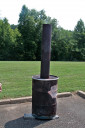
Biochar is a soil amendment made typically from bio-mass through a process called pyrolysis with low-oxygen. By using a low-cost, easy-to-make biochar stove, communities can arrange to turn common waste products into biochar.
The vision behind this project is for healthy and resilient communities. This means that I prefer methods that promote local, DIY and community approach, so that it can quickly scale and adapt to different towns/cities.
Most importantly, carbon being the element behind Life has tremendous versatility. It can be used to filter water and then used as a soil amendment. Or it can be mixed to make better concrete composites for roads (asphalt) and concrete. It can improve manufacturing by making carbon fiber alloys.
Last but not least, it is done through a circular model of using waste such as wood sticks, bio-mass, paper, saw dust mills, anything with carbon, even plastics. The output heat can be captured for heating buildings and cooking stoves. The opportunities are endless.
Sizes of stove vary in function of available supply/demand dynamics. For more information, check the biochar-international.org or Ithaka International.
Thank you.
PS: Stockholm, Sweden has achieved this recently. If the Swedes can do it, we can learn from them and improve together!
http://www.nordregio.org/sustainable_cities/stockholm-biochar-project/
Some guidelines for background and context
https://www.biochar-international.org/wp-content/uploads/2018/04/IBI_Pyrolysis_Plant_Guidelines.pdf
nes.city
A global network of shared equity rent-to-own properties, offering liquid equity transferring to other properties globally. This will be as if the tenant is co-investing into a 'green REIT' fund along with CSR programs and NGOs, which we will use the crowdfund purchasing new properties, or reinvesting into sustainable urban development, and social entrepreneurs. The vision is to make a new type of bank persay, that offers an AirBnB+WeWork but connected with more community initiatives, like co-living spaces do, however we want to focus on spurring economic development and sustainability for low-medium income communities.
Looking for collaborators to work together and spread this vision.
Add me on LinkedIn and let's chat:
linkedin.com/in/alanjgreenspan
Smart Public Lighting in municipality of Renkum

The municipality of Renkum wants to switch to smart public lighting throughout the municipality and at the same time build an infrastructure for future Smart City applications, preferably with as few investments as possible. In response to this wish, Luminext (smart lighting), CityTec (service partner) and Primevest Capital Partners (financing) started a partnership to make this project possible.
Kevin Groen, project leader for the municipality of Renkum: “We have been busy in recent years for the tender for new public lighting. We are in need of replacement; our area is outdated and some lampposts are about to fall over. So we cannot wait until the first lampposts are replaced. We are looking forward to a great collaboration in a unique tender form!”
More information:
Please contact Mirjam Endendijk, Manager Marketing & Communications Luminext: <a>mirjamendendijk@luminext.eu</a>
Program Smart Mobility Amsterdam 2019 - 2025

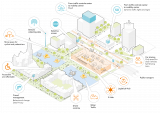
An accessible, liveable and less polluted city: this is what we’d like to achieve for residents, visitors and businesses in Amsterdam today and for future generations. Smarter and cleaner mobility can help us realise these aims. As a city, we want to offer Amsterdammers, commuters and visitors alternatives to the present forms of mobility, providing a door-to-door solution and contributing to our aims. This includes shared electric transport, from cars to bikes, in ‘Neighbourhood eHubs’ (eBuurthubs) established in cooperation with local residents. That way, we can use clean modes of transport and create more space in the city by sharing. We can then use this extra space to improve liveability.
More info and link to the program via www.amsterdam.nl/smartmobility
Check the report:
https://www.amsterdam.nl/wonen-leefomgeving/innovatie/smart-mobility
Actions
To achieve the ambitions, we will start working with two program lines:
1. Data and digitization
This program line helps the municipal organization digital tools and skills to ensure sufficient control in the future be able to rely on mobility in the city and around
improve quality in public spaces. We are working towards a mobility center of the
future. For this we will use the take the following steps:
• A shared basis: building a strong one data position
• A level playing field: frameworks
• Learning by doing: from traffic management to mobility management
• Ready for the future: aware of the consequences of digitization of mobility
2. Innovative mobility solutions
In this program we work together on concrete smart and clean alternatives to transport, so that Amsterdammers and visitors to the city are less dependent on their own car. We do this by setting up projects in certain urban areas and for specific target groups. We also focus on smart city logistics and we explore the possibilities of transport by water and air. Special attention is given to vulnerable groups and Amsterdam residents with a small grant. We improve the range of new affordable mobility concepts and increase demand, we grow into smart mobility city number 1 with a better and accessible mobility system for everyone. For this we will include the following in this program:
• Smart organization of mobility in the city: travelers are working on alternatives to possessing cars and initiating behavioral change.
• Smart fitting and efficient deployment of new mobility solutions: creating space for new concepts in the city and scaling up
• Anticipate on technological innovations: insights into new opportunities and collaborations. The report contains an overview of the various projects started in the previous program that are still running and newly started activities.
Civic Space

Civic Space helps local authorities make more informed decisions. We constantly collect and analyze the comments, ideas and suggestions of each citizen of the platform. Our software for civic participation enables local governments to take advantage of the collective minds of citizens and better understand the needs of their citizens.
We believe that with the Civic Space platform, we will give the public the opportunity to influence socially-minded decisions, to engage in joint policy-making with the municipal authorities.
Civic Space - is online citizen participation platform for adding citizens to city governance
The platform facilitates a bilateral dialogue between the municipal government of the city and its inhabitants. Citizens publish ideas, take part in competitions, public consultations, debates, implement joint projects in a convenient and accessible form.
The municipal authorities of the city consult with their citizens by conducting online debates, public consultations, polls or holding a contest of creative solutions for the existing problem. The platform helps cities turn to the collective intelligence of citizens. Understand, hear citizens. Become more sensitive to the needs of the public.
Civic Space, it helps local governments become more citizen-oriented.
Civic Space, it helps citizens participate in the process of managing a city, making decisions, and developing local policies.
Thanks to our user-friendly cloud solution, we significantly simplify the process of communication, and the attraction and cooperation of the most vulnerable segments of the population. Like any similar Internet solution, the platform allows you to join the process of participation of all segments of the population despite religion, gender, political preferences, nationality, skin color and participate in the discussion on equal terms with all other participants.
The platform allows everyone to express their opinion, suggestion, comment on equal terms, and so receive an answer, comment, recommendations from other participants of the platform.
Also, the cloud service platform, due to the absence of the need for administration, moderation, support and maintenance of the platform, allows residents of small towns to join the process of participation. The availability of Internet access is all that is necessary for city residents in order to join the platform.
We make attracting citizens to participate affordable, easy, understandable and convenient!
Metropoolregio Amsterdam Maquette

Werkmaquette Metropool Regio Amsterdam 2019 1:20.000
Deze maquette helpt, bij overleg met verschillende partijen, om standpunten duidelijk te maken. De maquette is nodig om problematiek van een dichtbevolkte regio in beeld te brengen. Daarbij kan het gaan over verkeersknooppunten, over bouwlocaties, maar ook over geluidsoverlast of over natuurbeheer. De vormgeving van de maquette is door mij ontworpen en gemaakt voor een grote en toch ook diverse gebruikersgroep van beleidsmakers en belanghebbenden in opdracht van de Gemeente Amsterdam
Interactieve Planbespreking
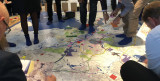
De maquette is zo groot als een tapijt, met een formaat van 440cm x 312cm. Het bestaat uit meerdere panelen. Tijdens besprekingen kan er op de maquette worden gelopen. Een blauw Poly Urethaan matte lak vormt de onderlaag. Daarop is, eveneens met een UV bestendige lak, de cartografie op de panelen geprint. De blauwe zeepkisten bevatten legenda items die op de kaart kunnen worden gelegd. Alle legenda items kunnen weer weg worden gehaald of verplaatst. (De opstelling op deze foto is een schetsmatige weergave en bevatten geen inhoudelijk plan.)
Legenda; kleur, vorm en materiaal
Voor het maken van de legenda heb ik onderzoek gedaan naar de te gebruiken iconografie; in welk materiaal en in welke kleur de artefacten verbeeld moeten worden. Dit kleurgebruik, het icoon, het materiaal (en zelfs de mate van transparantie) zijn alles bepalend. Dankzij dit systeem is de legenda flexibel en zij kan zelfs makkelijk worden uitgebreid. Deze legenda-taal zorgt voor een begrijpelijk geheel en het helpt mensen om er snel mee aan de slag te kunnen gaan. Met het kleurschema kunnen zelfs abstracte begrippen worden verbeeld, zoals geluidoverlast (en hoeveel dan) of bijvoorbeeld aantallen arbeidsplaatsen. De maak methode van de artefacten op de maquette varieert van laseren, 3d printen en rijgen, tot plakken en knippen.
Kijk voor meer informatie bij www.minkeproducts.com
WarmBouwen-pilot in Amsterdam

NL
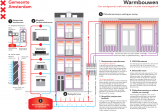
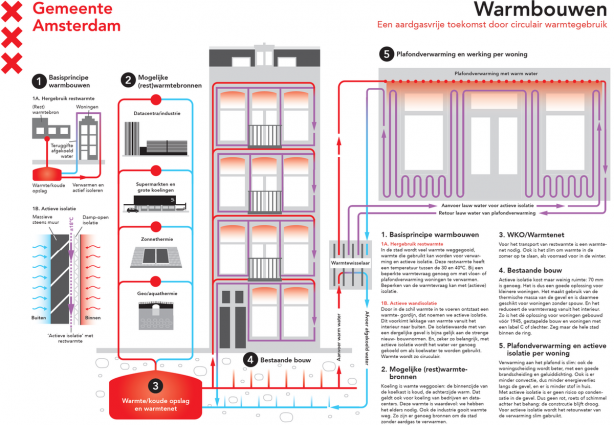
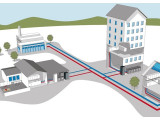
WarmBouwen is een techniek die gebruik maakt van restwarmte bij het isoleren van woningen. De techniek zorgt ervoor dat de buitenschil van de woning op temperatuur blijft waardoor er vrijwel niet verwarmd of gekoeld hoeft te worden. De restwarmte wordt door dunne buisjes in combinatie met (duurzaam) isolatiemateriaal op de wand geplaatst. De techniek is makkelijk te plaatsen, het isolatiemateriaal is slechts enkele centimeters dik en daardoor makkelijk toe te passen in de bestaande woningen in Amsterdam (zie de infographic voor een duidelijke toelichting).
EN
Warmbouwen is a technique that makes uses of residual heat in the insulation of houses. The technique ensures that the outer shell of the house stays on temperature with the result that there is barely any heating or cooling needed. The residual heat goes through small tubes and is combined with an (sustainable) insulation material, this combination is then placed on the wall. The technique is easy to install, the insulation material combined with the tubes is just a few centimeters thick and so easy to apply in existing houses in Amsterdam.

DeZONNET

A residential area in Haarlem dating from the 1930s is planning to test a new design with locally-generated solar heat, heat pumps, and an aquifer thermal energy system (ATES) in the subsurface. If the trial succeeds, this approach could be a good way of making older homes more sustainable and disconnecting them from the gas mains. The design saves a lot more carbon than other gas-free solutions.
Delft University of Technology, Greenvis, Deltares and other parties are working together to investigate the technical and economic feasibility of the ‘DeZONNET’ concept. The idea consists of a low-temperature heat network fed by solar heat from solar panels that generate both electricity and heat. Some of this heat is used directly and some is stored on a seasonal basis in one or more ATES systems, reducing the requirement for external energy input to a minimum. The design delivers the heat required while using little electricity from outside sources and without other heat sources. This not only results in a gas-free solution, it also leads directly to maximum carbon savings.
Applicable in existing residential areas
A unique aspect of the project is that existing technologies are combined to produce an area-based energy concept that makes maximum use of locally produced energy. The temperature of the locally produced heat is raised by a heat pump in each home to heat the home and deliver hot tap water. Each individual system is linked to a low-temperature heat network and an ATES for heat exchange and the seasonal storage of heat. This combination makes it possible to apply the DeZONNET concept in new and existing residential areas.
The parties involved are examining technical and economic feasibility, and also looking at social considerations, including which residents want to participate and subject to which conditions. Deltares is looking at whether the heat network can circulate heat quickly enough from the homes to the area level and vice-versa. In other words, whether it is possible to regulate the system in a stable way. ‘We use our WANDA calculation model to simulate all the pipelines, the connections in the systems and the different temperatures at the home and area levels,’ says Sam van der Zwan, an expert in pipeline hydraulics at Deltares. ‘That allows us to play with all the components and see how we can regulate the system as well as possible.’ In addition, Deltares is producing a design manual for the DeZONNET concept so that it can also be used in other residential areas.
The results will be published at the end of this year. The project is being funded by the Netherlands Enterprise Agency (RVO) as part of the Energy Top Sector. It is part of the Haarlem Climate Agreement signed on 8 March 2019. The consortium for DeZONNET concept consists of: TU Delft faculty of Architecture, Deltares, DE Ramplaan Foundation and project SpaarGas, Greenvis, De WarmteTransitieMakers, ENGIE, Triple solar and Fortes Energy Systems.
Tarnaveni Smart City App

With this application, we want to facilitate communication between citizens and the city hall. We want citizens to be actively involved in city development and problem solving by reporting issues directly through the application. The city hall can keep citizens informed about the infrastructure works that are taking place through constant updates. We also managed to eliminate a huge parte o birocracy through ANA, the only virtual public official based on artificial intelligence from Romania, it provides useful information to users about the services offered by public institutions. The application also supports local economics by enabling companies to list their vacancies jobs in the application, as well as promoting local products through a special section. The application wants to improve the cultural activity of the city so we constantly announce users about the cultural events that take place.
Digital Perimeter

By implementing innovative smart & digital solutions, the digital perimeter allows us to experiment with applications that deliver safety & security while providing the visitor with an even better fan experience.
Please do share your comments and thoughts with us as we are currently exploring our technical options with partners within the eco-system.
RiRa Amstel III heat net project

Recycling residual heat from Equinix datacenters to buildings in Amstel III area. Amstel III is one of the largest business regions in Amsterdam and the Netherlands with 250 hectares area and 720.000 m2 gross office space. Datacenters are generating enormous amounts of residual heat that normally is released to the outside water or air. In this project we will be able to re-use the heat for heating processes in the build environment in this area.
Amsterdam Innovation Tour

Those with an interest in urban innovation topics can now discover what makes Amsterdam an innovative, smart city without the timing and logistical constraints of a guided tour. The new self-guided Amsterdam Innovation Tour enables local and international stakeholders to immerse themselves in learning about the City’s innovative projects at any time — day or night.
Smart Stedenbouw

In the light of the technologization and digitalization we're going through at the moment, we recognize the need to rethink urban design. Thanks to the internet, we can be anywhere we want. Thus changing the needs of a city's citizens. Additionally, smart city applications in public space raise questions regarding privacy and ownership.
Local food production increase biodiversity

Controlled environment agriculture offer many advantages to local communities; farming of crop of choice, balanced demand and supply, socio-economic wellbeing, an efficient circular economy, local self-sufficiency of chosen crop, stronger economy and an improved standard of living.

5G

5G will be the new generation of mobile connectivity. The connection will be faster and more reliable, and will bring previously unknown possibilities for citizens and business. Amsterdam is exploring the opportunities and obstacles on the road to a safe and useful 5G network. One of the ways we do this is with our field lab in Amsterdam South East, from the train station to the Johan Cruijff ArenA. But also through regional, national and international collaborations.
Amsterdam Data Exchange (AMDEX)

If data is the new gold, how can we ensure that we can all benefit from the possibilities?
Read the report about the principles of AMDEX (link)
The idea originated during the Science and Business dinner organized by Amsterdam Science Park (ASP). With Science Park’s history in the field of technological innovation and digital connectivity, the Amdex was a logical next step. As argued by Margo Keizer (ASP), "data sharing is already happening here, but at an informal level. We bring all these different initiatives together. To do this, we need to address various infrastructural and legal issues." The Amsterdam Data Exchange is an initiative to do exactly that, she adds.
Wouter Los questions: "how can we work efficiently with all this data?” With his extensive experience in the European scientific community, Los helped in the investigation of the function of the data marketplace. He explains "we want to go to an open, democratic playing field. In this model - in contrast to the monopolistic models that you now come across - the data remains from its owner and they decide which data can be shared with whom and under what conditions. We build a market model in which everyone is able to consult and use data in a transparent, familiar manner."
Chief Technology Officer, Ger Baron mentions, "since 2011, the municipality have had an open data policy. Municipal data is from the community and must therefore be available to everyone, unless privacy is at stake. In recent years we have learned to open up data in different ways.” He adds, “panorama photos, for example, are freely accessible on our data portal. In addition, we share data with market parties to find a parking space. We want to share data, but under the right conditions. This requires a transparent date market which is exactly what the Amsterdam Data Exchange can offer."
The I-AVA method for schools

The areas of concern, which fall under the broad umbrella of sustainability and fashion, have long been given prominence by numerous authors within the industry. However, as stated by Hur, Beverley & Cassidy (2013 p. 90), “the term still remains confusing and ambiguous and many designers still find it difficult to understand [this] concept”. While the aim of sustainable fashion may have be- come somewhat clearer than the term itself, the methods of how to achieve sustainability may not be as clear (Aakko & Koskennurmi-Sivonen 2013). The focus on minor aspects, like environmentally friendly fabrics (Hur, Bever- ley & Cassidy 2013) is simply not enough.
The I-AVA method is a systemic methodology that has been developed with the aim of making sustainability in fashion more accessible to designers. Currently, sustainability within the fashion industry is communicated as a separate value, rather than an integral one. This is evidently seen through the lack of education between existing designers; especially SME brands who have tend to have more limited time, money and resources to invest in educating themselves. With a clearly established knowledge gap, it is therefore crucial to begin working from the ground up and begin filling this gap through educational inputs at student levels.
The I-AVA Method has been created to place sustainability in fashion into a systemic framework. It aims to give fashion design students the ability to better understand how sustainability may be applied to the core of their work and potential business. The method focuses on eradicating sustainability as a single issue and tackling it holistically and experientially. By understanding the interconnected ideas of shared value and the stakeholder model, sustainability will be implemented throughout the supply-chain. It is divided into four main action steps (Immerse, Assure, Vocalize and Achieve) containing practical tools and information that are communicated in a simple and more straightforward manner.
Using the Hannover Principles as the main inspiration, the I-AVA method evolves around three ‘mind-set layers’ (Table 2.4). These engage the users with requirements needed to approach sustainability in fashion: empathy, circularity & transparency. These layers will be present in the action step two and three (Vocalize and Achieve) and will guide users to establish their own priorities within the steps. The final output therefore generates an individual sustainable definition for each user.
The I-AVA Method aims to provide a space for designers that equips them with the communication, resources and applicability. The method is built in a way that requires two kinds of actions: ‘standard actions’ and ‘personalised actions’.
The first two action-steps (Immerse and As- sure) operate as ‘standard actions’ for all users, ensuring that the basic requirements of sustainability are understood and applied. In understanding the importance for small brands not to tackle too many issues at once (Vinck 2017), the last two action-steps (Vocalize and Achieve) operate as ‘personalised actions’. These allow users to create unique definitions of sustainability in fashion, leading to a more focused, specialized and unique approach. Eventually all four actions will serve as a platform of reflection on which users can trace their definition, allowing them to further implement sustainability as they go along.
FABULOS

FABULOS (Future Automated Bus Urban Level Operation System) is a European research and development project to establish and deliver a systemic proof-of-concept for automated last mile public transport as part of the existing transport system of urban areas, based on the use of self-driving minibuses. The FABULOS project has received funding from the European Union’s Horizon 2020 research and innovation programme and runs from 1 January 2018 until 31 December 2020. The FABULOS project has partners in Estonia, Finland, Greece, the Netherlands, Norway and Portugal. The six procuring partners use Pre-Commercial Procurement as a tool to co-create an innovative solution together with multiple companies. Contracts have been signed in December 2018 with 5 consortia. The first Phase (feasibility study) starts in January 2019. Actual piloting of fleets of robot buses takes place in all 6 partner cities from Spring 2002 onwards.
Most recent press release: https://fabulos.eu/five-consortia-awarded-contracts-in-fabulos-pre-commercial-procurement/
The FABULOS consortium has finalised the evaluation of the tenders in December 2018 and has awarded five consortia with contracts. The aim of these contracts is to facilitate procurement of R&D work to develop systems capable of operating fleets of automated minibuses. As a first step towards this goal, each consortium will conduct a feasibility study of proposed solutions and technologies.
After the closing of the FABULOS request for tenders on 31 October 2018, the tenders were assessed by the Technical Evaluation Committee. In addition to commercial feasibility and project management, nine functional criteria and three non-functional criteria were used. The functional criteria range from fleet management and remote operation and all the way to requirements for vehicle capabilities in mixed traffic. Societal and legal aspects form elements of the non-functional criteria. The fleet is expected to drive in mixed traffic, at urban speeds, in nearly in all weather conditions and without a conductor on board.
“We were positively surprised by the high quality of tenders received and were pleased to discover so many exceptional solutions to the FABULOS challenge. It will be very exciting to see these proposed solutions become a reality by the end of 2020,” summarises Technical Chair of the Evaluation Committee Oscar Nissin, from Metropolia University of Applied Sciences.
Five European consortia have succeeded in the first stage of the competition. In total, 16 companies from six European countries formed consortia as follows:
- The FVF Consortium consisting of three Finnish partners: Fortum Power and Heat Oy, Fleetonomy.ai Oy and VTT Technical Research Centre of Finland.
- The Kompai-Actia Consortium consisting of two French companies: Kompaï Robotics and Actia Automobile.
- The Mobile Civitatem Consortium consisting of four partners from Estonia: Modern Mobility Oü, Tallinn University of Technology, Silberauto Eesti AS and Ecofleet Eesti Oü. The fifth member of the consortium is the Danish company Autonomous Mobility A/S.
- The Saga Consortium consisting of four Norwegian partners: Halogen AS, Forus PRT AS, Spare Labs Inc. and Ramboll Management Consulting AS.
- The Sensible 4 – Shotl Consortium consisting of two partners: Sensible 4 from Finland and Shotl from Spain.
The total FABULOS procurement budget is around 5,500,000 euros (incl. VAT). The maximum budget for individual suppliers involved in all three phases is over 1,000,000 euros (incl. VAT).
Stay up to date
Get notified about new updates, opportunities or events that match your interests.